gurjinderdigital.in

Author name: Gurjinder Singh

Social Media Marketing

Social Media Marketing

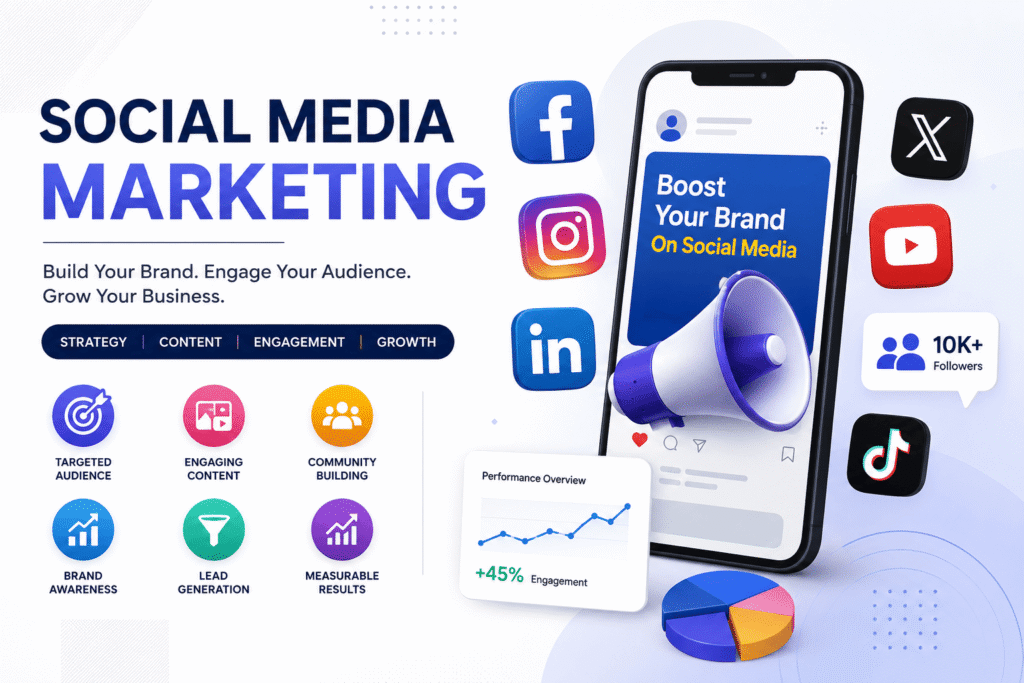
Social Media Marketing Introduction Start the article by introducing Social Media Marketing (SMM) and explain how it has become one of the most powerful digital marketing strategies for businesses of all sizes. Mention that billions of people actively use platforms like Facebook, Instagram, LinkedIn, X (formerly Twitter), YouTube, Pinterest, Snapchat, and TikTok every day, making social media an essential channel for connecting with potential customers. Explain that social media is no longer just a platform for sharing personal updates. It has evolved into a powerful business tool for increasing brand awareness, building customer relationships, generating leads, driving website traffic, and boosting sales. Discuss how businesses can use organic content, paid advertising, influencer marketing, and community engagement to reach their target audience. Conclude the introduction by giving readers an overview of the topics covered in the article, including the basics of social media marketing, its importance, different platforms, effective strategies, common mistakes, useful tools, and future trends. What is Social Media Marketing? Define Social Media Marketing (SMM) as the process of using social media platforms to promote a business, product, or service while building meaningful relationships with customers. Explain that SMM involves creating and sharing valuable content, interacting with followers, running paid advertising campaigns, and analyzing performance to achieve marketing goals. Discuss how businesses use text posts, images, videos, stories, reels, live streams, polls, and user-generated content to engage audiences. Explain that successful social media marketing focuses on understanding customer interests, creating consistent brand messaging, and delivering content that educates, entertains, or inspires. Also mention that social media marketing complements other digital marketing channels such as SEO, content marketing, email marketing, and Google Ads. Why Social Media Marketing is Important Explain why social media marketing is essential for modern businesses. Discuss how it helps increase brand awareness, reach a wider audience, improve customer engagement, generate qualified leads, and drive website traffic. Highlight that businesses can communicate directly with customers, respond to questions quickly, and build long-term trust through regular interaction. Mention that social media also provides valuable insights into customer behavior, preferences, and feedback, helping businesses improve products and services. Explain that compared to many traditional advertising methods, social media marketing offers a cost-effective way to promote brands while delivering measurable results. Include examples of how startups, local businesses, e-commerce stores, and multinational companies use social media to strengthen their online presence and remain competitive. Types of Social Media Marketing Explain that social media marketing includes multiple strategies designed to achieve different business objectives. Organic Social Media Marketing Discuss creating regular posts, stories, reels, videos, and educational content without paid promotion. Explain how organic marketing helps build brand authority, increase engagement, and nurture customer relationships over time. Paid Social Media Advertising Describe paid campaigns on Facebook, Instagram, LinkedIn, TikTok, Pinterest, and X. Explain audience targeting based on demographics, interests, behaviors, location, and online activity. Mention objectives such as brand awareness, lead generation, website traffic, app installs, and conversions. Influencer Marketing Explain how businesses collaborate with influencers and content creators to promote products or services to their followers. Discuss the benefits of authenticity, trust, and reaching niche audiences. Community Management Describe the importance of responding to comments, messages, reviews, and customer feedback. Explain how active community management improves customer satisfaction and strengthens brand loyalty. Video Marketing Discuss the growing popularity of short-form videos, reels, YouTube Shorts, and live streaming. Explain how video content increases engagement, improves reach, and captures audience attention more effectively than static posts. Key Social Media Marketing Success Factors Explain the factors that contribute to successful social media marketing campaigns. Discuss creating high-quality and engaging content, maintaining a consistent posting schedule, understanding the target audience, using relevant hashtags, writing compelling captions, and designing visually appealing graphics and videos. Mention the importance of audience engagement through comments, direct messages, polls, and interactive content. Explain how analytics, reach, impressions, engagement rate, click-through rate (CTR), conversions, and follower growth help measure campaign success. Also emphasize the value of adapting content based on platform algorithms and audience preferences. Best Social Media Marketing Strategies Provide practical strategies for improving social media performance. Explain the importance of creating a content calendar, posting consistently, using high-quality visuals, and developing a unique brand voice. Encourage businesses to mix educational, promotional, entertaining, and user-generated content to keep audiences engaged. Discuss leveraging trending topics, collaborating with influencers, using paid advertisements to expand reach, optimizing content for each platform, and analyzing campaign performance regularly. Recommend A/B testing different content formats, posting times, and advertising creatives to identify what delivers the best results. Emphasize that successful social media marketing requires continuous experimentation and optimization. Common Social Media Marketing Mistakes Discuss common mistakes businesses make on social media. Explain why inconsistent posting, ignoring audience engagement, publishing overly promotional content, using poor-quality visuals, and targeting the wrong audience can reduce campaign effectiveness. Mention the importance of avoiding negative customer interactions, failing to monitor analytics, copying competitors without developing a unique strategy, and neglecting mobile-friendly content. Encourage businesses to review performance regularly and make improvements based on audience feedback and data insights. Best Social Media Marketing Tools Introduce popular tools that help businesses manage and optimize their social media marketing efforts. Explain the purpose of: Explain how these tools save time, improve content quality, automate scheduling, and provide valuable performance insights. Conclusion Summarize the key points discussed throughout the article by emphasizing that Social Media Marketing is one of the most effective ways to build brand awareness, engage customers, generate leads, and increase sales in today’s digital world. Highlight that success depends on understanding the target audience, creating valuable content, maintaining consistency, and continuously analyzing performance. Encourage readers to combine social media marketing with other digital marketing strategies such as SEO, Google Ads, Content Marketing, and Email Marketing to achieve even better results. Conclude by reminding businesses that staying updated with platform trends, experimenting with new content formats, and adapting to changing algorithms are essential for achieving sustainable growth and long-term success on social media.
Google Ads, SEO

Google Ads

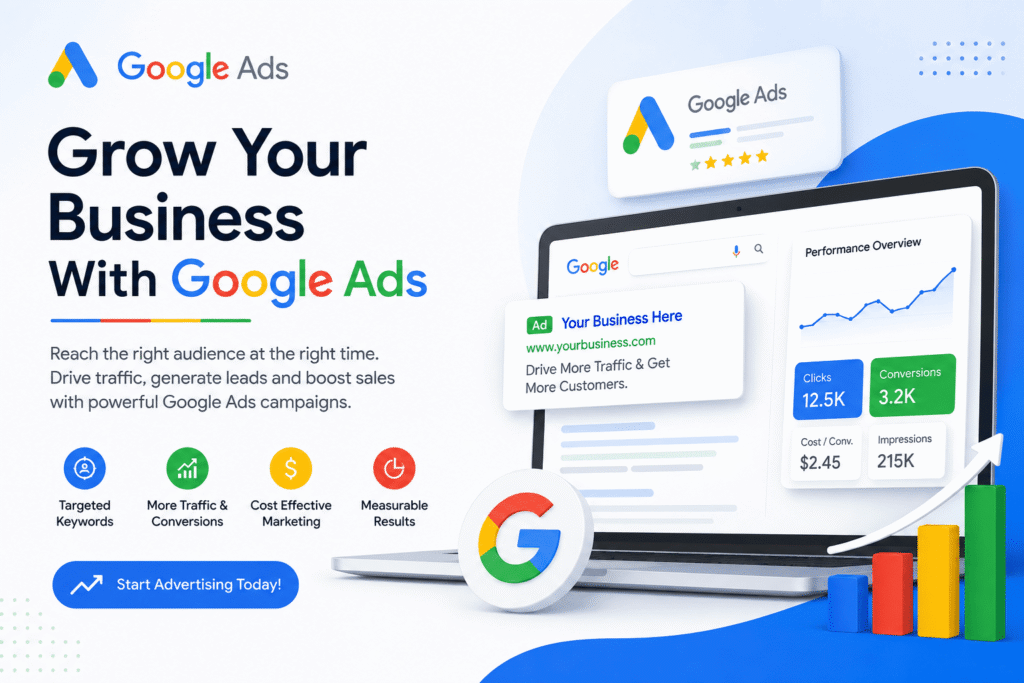
Introduction Begin the article by introducing Google Ads as one of the most effective online advertising platforms for businesses of all sizes. Explain that in today’s competitive digital world, simply having a website is not enough. Businesses need targeted advertising to reach potential customers who are actively searching for their products or services. Mention that Google Ads allows advertisers to display ads across Google Search, YouTube, Google Maps, Gmail, the Google Display Network, and millions of partner websites. Explain that Google Ads follows a Pay-Per-Click (PPC) model, meaning advertisers generally pay only when someone clicks on their ad. Highlight how businesses can set their own budgets, choose their target audience, monitor campaign performance in real time, and optimize ads for better results. Conclude the introduction by telling readers that this guide will cover what Google Ads is, why it matters, campaign types, ranking factors, best practices, common mistakes, useful tools, and tips for creating successful advertising campaigns. What is Google Ads? Define Google Ads as Google’s online advertising platform that enables businesses to promote products and services through paid advertisements. Explain that advertisers bid on relevant keywords so their ads can appear when users search for related information on Google. Describe how Google uses an auction system that considers both the advertiser’s bid and the Quality Score to determine which ads appear and in what order. Explain that Google Ads supports multiple advertising formats, including text ads, image ads, video ads, shopping ads, and app promotion ads. Mention that businesses can target users based on keywords, location, language, device, interests, demographics, and online behavior. Also explain the difference between organic search results, which are earned through SEO, and paid ads, which appear because advertisers invest in Google Ads. Emphasize that Google Ads delivers fast visibility while allowing businesses to measure clicks, impressions, conversions, and return on investment (ROI). Why Google Ads is Important Explain why Google Ads has become an essential part of digital marketing. Discuss how it helps businesses reach customers exactly when they are searching for products or services, making it one of the most effective forms of intent-based marketing. Mention that businesses can increase brand awareness, generate qualified leads, boost website traffic, and drive online or offline sales through targeted advertising. Highlight the flexibility of Google Ads, allowing advertisers to choose daily budgets, bidding strategies, geographic targeting, and audience segmentation according to business goals. Explain that detailed reporting and conversion tracking help businesses measure campaign performance and make data-driven decisions. Also discuss how Google Ads benefits local businesses, e-commerce stores, startups, service providers, and large enterprises by delivering scalable advertising solutions that can grow with the business. Types of Google Ads Campaigns Introduce the various campaign types available in Google Ads and explain how each serves different marketing objectives. Search Campaigns Explain that Search Campaigns display text advertisements on Google’s search results when users search for relevant keywords. These campaigns are ideal for generating leads, inquiries, phone calls, and website traffic from users with high purchase intent. Display Campaigns Describe Display Campaigns as visually engaging banner advertisements shown across millions of websites, mobile apps, and Google-owned platforms. Explain how these campaigns help build brand awareness, retarget previous visitors, and reach new audiences. Shopping Campaigns Explain that Shopping Campaigns are designed for e-commerce businesses. They display product images, prices, reviews, and store information directly in Google Search, making it easier for customers to compare products before purchasing. Video Campaigns Discuss Video Campaigns on YouTube and partner websites. Explain how businesses use video advertising to increase brand awareness, product demonstrations, customer engagement, and conversions through engaging visual content. Performance Max Campaigns Explain that Performance Max uses Google’s artificial intelligence to automatically optimize campaigns across Search, Display, YouTube, Gmail, Discover, and Maps. Highlight its ability to maximize conversions by finding the best audience and placements. App Campaigns Describe App Campaigns, which help businesses promote mobile applications by increasing app downloads, user engagement, and in-app conversions across Google platforms. Demand Gen Campaigns Briefly explain Demand Gen campaigns, which use visually rich creatives to reach users across YouTube, Discover, and Gmail. These campaigns are particularly effective for generating awareness and demand before customers actively begin searching. Key Google Ads Ranking Factors Explain that Google determines ad placement using several important ranking factors rather than considering only the highest bid. Discuss Quality Score, which measures ad relevance, expected click-through rate (CTR), and landing page experience. Explain that advertisers with highly relevant ads often achieve better positions while paying lower costs. Describe the importance of keyword selection, bidding strategy, ad copy quality, landing page speed, mobile responsiveness, ad assets (extensions), user location, device type, and audience targeting. Mention that Google also considers the competitiveness of the auction and the overall user experience when calculating Ad Rank. Emphasize that improving these factors can increase visibility while reducing advertising costs. Best Google Ads Strategies Provide practical strategies for running successful Google Ads campaigns. Explain the importance of conducting detailed keyword research to identify high-intent search terms. Recommend writing compelling headlines and persuasive descriptions with clear calls to action that encourage users to click. Discuss optimizing landing pages to match ad messaging and provide a smooth user experience. Explain the value of using ad assets such as sitelinks, call extensions, location extensions, and structured snippets to improve ad visibility. Encourage businesses to monitor conversions, perform A/B testing, adjust bidding strategies, add negative keywords, remarket to previous website visitors, and continuously optimize campaigns based on performance data. Reinforce that consistent monitoring and improvement are essential for long-term advertising success. Common Google Ads Mistakes Discuss common mistakes that reduce campaign performance and increase advertising costs. Explain why targeting overly broad keywords, ignoring negative keywords, creating weak ad copy, or sending users to irrelevant landing pages often leads to poor results. Mention technical issues such as slow-loading pages, lack of mobile optimization, and failing to track conversions. Also explain the risks of choosing the wrong bidding strategy, ignoring audience segmentation, failing to test different ad variations, and neglecting campaign

SEO

SEO

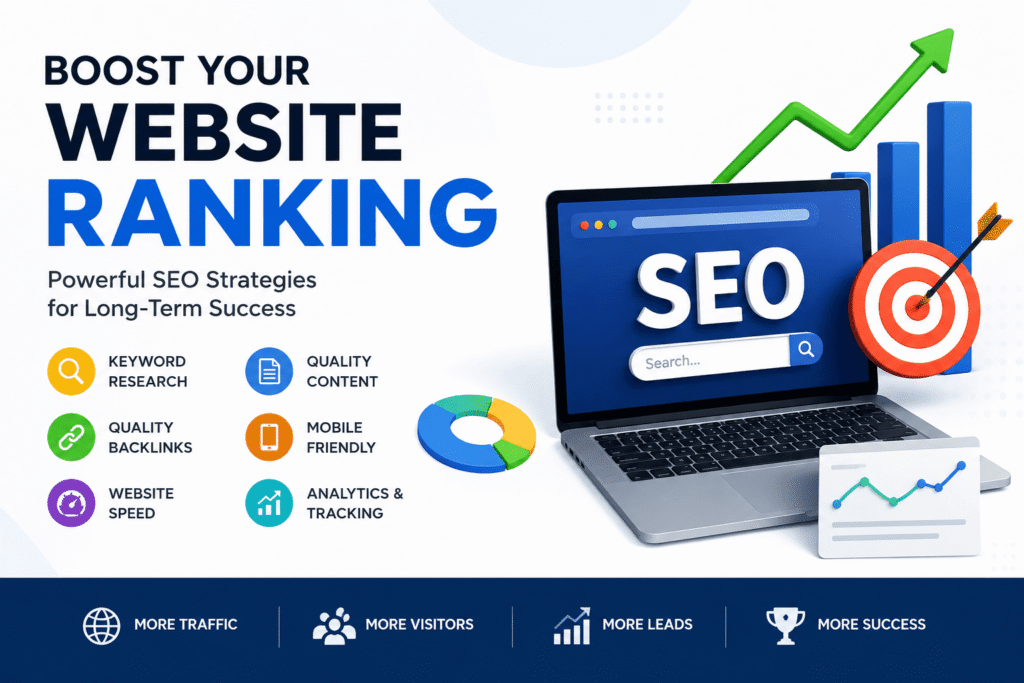
SEO SEO (Search Engine Optimization) is the process of optimizing a website to improve its visibility in search engine results on platforms like Google. The goal of SEO is to attract more organic (unpaid) traffic by making a website more relevant, user-friendly, and search engine-friendly. It involves optimizing content, keywords, website speed, technical performance, and backlinks to achieve higher rankings. Effective SEO helps businesses increase brand awareness, generate quality leads, and achieve long-term online growth. Introduction Start the article by introducing Search Engine Optimization (SEO) and its growing importance in today’s digital landscape. Explain how millions of people use search engines like Google every day to search for products, services, businesses, and information. Discuss why simply having a website is no longer enough and why businesses need SEO to stand out in search results. Mention that SEO helps websites attract organic traffic, improve online visibility, build trust, and generate qualified leads without relying solely on paid advertising. Briefly explain how search engines work by crawling, indexing, and ranking web pages based on relevance and quality. End the introduction by giving readers an overview of what they will learn in the article, including the basics of SEO, its different types, ranking factors, best strategies, common mistakes, and the essential tools used by SEO professionals. What is SEO? Define SEO in simple yet professional language. Explain that Search Engine Optimization (SEO) is the process of improving a website’s visibility on search engine results pages (SERPs) through various optimization techniques. Clarify that the main objective of SEO is to attract relevant visitors who are actively searching for products, services, or information related to a business. Describe how search engines like Google use bots to crawl websites, index pages, and rank them based on hundreds of ranking factors. Introduce key SEO concepts such as keywords, search intent, content quality, website structure, and user experience. Also explain the difference between organic search results and paid advertisements, highlighting that SEO focuses on earning free, long-term traffic through quality optimization rather than paying for every click. Why SEO is Important Explain why SEO has become one of the most valuable digital marketing strategies for businesses of all sizes. Discuss how SEO helps increase organic website traffic, improve brand visibility, build customer trust, and generate high-quality leads. Mention that users generally trust websites that appear on the first page of Google more than those that appear lower in search results. Describe how SEO provides a better return on investment (ROI) compared to many paid advertising methods because it delivers sustainable traffic over time. Explain how good SEO also improves website speed, mobile usability, and overall user experience, leading to higher engagement and conversion rates. Include examples of how local businesses, e-commerce stores, startups, and service-based companies use SEO to reach their target audience and stay competitive in today’s digital marketplace. Types of SEO Begin by explaining that SEO consists of several specialized areas, each focusing on different aspects of website optimization. On-Page SEO Explain that On-Page SEO involves optimizing the elements that appear directly on a website. Discuss keyword optimization, title tags, meta descriptions, headings, URL structure, image optimization, internal linking, content quality, and readability. Mention the importance of creating valuable content that satisfies user intent. Off-Page SEO Describe Off-Page SEO as activities performed outside the website to improve authority and credibility. Explain backlinks, guest posting, digital PR, influencer outreach, social media sharing, brand mentions, and online reputation management. Emphasize that high-quality backlinks from trusted websites are one of Google’s strongest ranking signals. Technical SEO Explain Technical SEO by covering website speed, Core Web Vitals, mobile responsiveness, HTTPS security, XML sitemaps, robots.txt, structured data (Schema Markup), canonical tags, crawlability, and indexability. Mention that strong technical SEO ensures search engines can efficiently understand and rank a website. Local SEO Discuss Local SEO for businesses serving specific geographic locations. Explain Google Business Profile optimization, local citations, NAP consistency (Name, Address, Phone Number), customer reviews, and location-based keywords. Mention that Local SEO helps businesses appear in Google Maps and local search results. Other Types of SEO Briefly introduce E-commerce SEO, International SEO, Enterprise SEO, and Video SEO, explaining when each is useful and how they support different business goals. Key SEO Ranking Factors Explain that Google uses hundreds of ranking signals, but several factors have a greater impact on search rankings. Discuss the importance of publishing original, informative, and high-quality content that matches user intent. Describe how keyword relevance, page speed, mobile-friendliness, HTTPS security, and Core Web Vitals influence both user experience and rankings. Explain why backlinks from authoritative websites increase trust and domain authority. Mention internal linking, optimized images, structured data, user engagement metrics, website architecture, and content freshness as additional ranking factors. Emphasize that successful SEO is achieved by improving multiple factors together rather than focusing on just one. Best SEO Strategies Provide practical strategies that businesses can implement to improve search rankings. Start with keyword research using reliable SEO tools to identify valuable search terms. Explain the importance of creating high-quality, original, and informative content that answers users’ questions. Discuss optimizing title tags, meta descriptions, URLs, images, and internal links. Explain how building high-quality backlinks through guest posting, digital PR, and content marketing strengthens website authority. Mention regularly updating old blog posts, improving page loading speed, optimizing for mobile devices, targeting featured snippets, using schema markup, and tracking SEO performance through analytics tools. Conclude by emphasizing that SEO is a continuous process that requires regular monitoring and optimization. Common SEO Mistakes Highlight the mistakes that often prevent websites from ranking well on Google. Explain why keyword stuffing, duplicate content, thin content, and poor-quality backlinks can negatively impact SEO performance. Discuss technical issues such as slow website speed, broken links, missing meta tags, poor mobile optimization, and incorrect indexing settings. Mention the importance of avoiding outdated SEO practices such as buying backlinks or over-optimizing anchor text. Explain that regularly auditing a website and following Google’s best practices helps businesses avoid penalties and maintain strong search performance. Best SEO

Digital marketing

Leading 8 PR Agencies in India Using Data-Driven Strategies

Leading 8 PR Agencies in India Using Data-Driven Strategies Introduction Public relations has changed shape over the last decade. It used to be judged almost entirely by column inches and television mentions, but today a PR agency’s digital footprint tells just as much of the story as its media book. Search visibility, in particular, has become a quiet but powerful signal of an agency’s standing: it reflects how often an agency is searched for by name, how consistently it ranks for the services it offers, how much organic traffic its own website pulls in, and how well it understands the SEO discipline it is increasingly asked to fold into client campaigns. An agency that ranks well for its own name and services is, in a small but telling way, proving that it can do for itself what it promises to do for its clients. This three-part series looks at a cross-section of PR agencies operating primarily in the Indian market, evaluated through the lens of search and digital visibility alongside their traditional PR credentials — scale, service breadth, client roster, sector specialization, and industry recognition. Part One opens with the market’s largest and most decorated independent firm. Part Two moves through a set of agencies that blend branding, digital marketing, and PR into more integrated offerings. Part Three closes with two agencies built around data-driven and consultative approaches, followed by a concluding comparison of what separates the agencies at the top of the search results from the rest of the field. It is worth noting upfront that “ranking by SEO” is not a single, universally agreed metric. It is a composite of visibility signals — organic search presence, domain authority built through PR placements and backlinks, brand search volume, and the depth of an agency’s own content strategy. The agencies profiled here are strong performers across most of these signals, though each brings a distinct approach and a different scale of operation to the table. Top PR Agencies Ranked by SEO Visibility and Digital Presence Businesses need a PR agency, especially in a time like this, where everyone checks the online reputation of a brand before making a move. The real challenge is finding a PR agency utilising data-driven strategies to bring results. Here we have enlisted the best PR firms using analytics in India: Ranking By SEO Before profiling individual agencies, it helps to unpack what “ranking by SEO” actually measures in the PR context, since the term gets used loosely. Organic search visibility. This is the most direct signal: how often does an agency’s website appear on the first page of results for terms like “PR agency in [city]” or “[industry] PR firm,” and how many long-tail keyword variations does it rank for? Agencies that publish frequently — blog posts, service pages tailored to individual cities or sectors, case studies — tend to accumulate far more ranking keywords than agencies that rely solely on a static homepage. Domain authority via earned media. PR agencies have a structural advantage here that most businesses do not: every successful placement in a reputable publication is also, in SEO terms, a backlink from a high-authority domain. An agency that regularly secures coverage in national business dailies, trade publications, and industry outlets is simultaneously building its own domain’s authority and its clients’. The agencies with the strongest earned-media track records — the ones with decades of placements behind them — tend to also show the strongest organic footprints, because the same relationships and reputation that win coverage also win links. Brand search volume. How many people search for the agency by name each month is a rough proxy for market recognition. Agencies that have been operating longest, or that have run high-visibility award shows, campaigns, or PR-for-PR efforts, generally see higher branded search volume than newer or more regionally focused firms. Service-page depth and local SEO. Agencies that maintain dedicated pages for each service line (media relations, crisis communication, investor relations, digital PR) and each city they operate in tend to rank for a much wider spread of queries than agencies with a single, general “services” page. This is a deliberate content strategy choice, and it shows up clearly in how many distinct search terms bring traffic to a given agency’s site. Measured against these four signals, a few names in the Indian PR landscape stand out clearly, starting with the market’s largest independent firm. Adfactors PR Adfactors PR occupies a position in Indian public relations that few competitors can match, and its digital visibility follows directly from that scale. <cite index=”10-1″>Founded in 1997 by Madan Bahal and Rajesh Chaturvedi, the firm is generally regarded as the largest independent public relations agency in India by fee income and headcount, with roughly 1,400 employees and fee income of approximately US$66 million as of 2025, placing it among the five largest PR firms headquartered in the Asia-Pacific region.</cite> That scale translates directly into search performance. <cite index=”4-1″>The agency describes itself as serving over 700 retained clients across 40 cities in India</cite>, and it maintains a sprawling network of city-specific and sector-specific pages — <cite index=”8-1″>separate location pages for offices spanning Mumbai, Jaipur, New Delhi, Bhopal, Bengaluru, and Hyderabad, among others</cite> — each one a distinct entry point for local search traffic. Its sector pages go equally deep: dedicated hubs exist for <cite index=”5-1″>new-economy clients such as e-commerce and startups, where the firm counts brands like Ola, Snapdeal, Nykaa, and Upstox among its partners</cite>, and for financial services, where <cite index=”7-1″>it has served over 100 financial institutions and has maintained a market-leading BFSI practice since 1997</cite>. Adfactors’ earned-media backbone is exceptional by Indian PR standards, which matters directly for domain authority. <cite index=”9-1″>The firm states it has managed every single IPO over a billion dollars in the Indian market over the last decade, with its share of IPOs by volume of funds raised running in excess of 75 percent.</cite> That level of transactional and capital-markets work generates consistent, high-authority coverage across financial media — exactly

Digital marketing

Digital Marketing

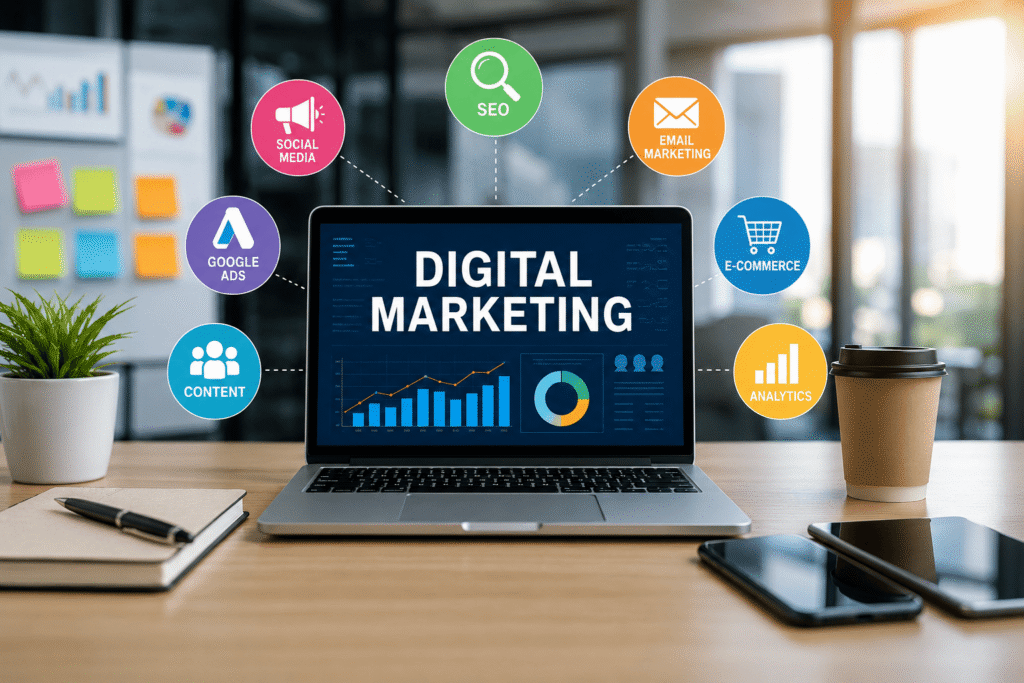
Digital Marketing: The Complete Guide to Growing Your Business Online Traditional marketing alone can no longer carry a business forward. Customers now research products, compare providers, and make purchasing decisions almost entirely online — which means a company’s digital presence has become as important as its product itself. Digital marketing gives businesses of every size, from local shops to global enterprises, a direct, measurable, and scalable way to reach the right audience and convert attention into revenue. What Digital Marketing Actually Delivers Digital marketing is the use of internet-based channels and technologies to promote products and services. What separates it from traditional advertising is precision: campaigns can be targeted by demographics, interests, location, and real-time online behavior. That precision means marketing spend goes toward people who are actually likely to buy — not a broad, undifferentiated audience. The result is advertising that feels less like a broadcast and more like a conversation with the right person at the right time. The other defining advantage is measurability. Every click, impression, and conversion can be tracked. Analytics platforms reveal exactly which channels drive traffic, which campaigns generate revenue, and where budget is being wasted. This turns marketing from a guessing game into a discipline of continuous, data-backed improvement. Search Engine Optimization: The Foundation of Organic Growth Search Engine Optimization (SEO) determines whether a business is visible at the exact moment someone is searching for what it offers. Since most buying journeys start with a search engine, ranking well on Google is not optional — it’s foundational. Strong SEO combines well-structured content, fast page performance, authoritative backlinks, and a frictionless user experience. Done correctly, it builds a compounding source of traffic that doesn’t disappear the moment ad spend stops. Content Marketing: Earning Trust Before Earning a Sale Content marketing — blogs, guides, videos, and infographics — works by solving problems before asking for a sale. Instead of pushing a product, it demonstrates expertise and answers the questions a potential customer already has. Businesses that publish consistently useful content build authority in their space, and that authority does double duty: it earns customer trust and it reinforces SEO by strengthening keyword relevance and topical depth. Social Media Marketing: Where Brands Build Relationships Platforms like Instagram, LinkedIn, Facebook, X, and YouTube let businesses do more than broadcast — they let brands respond, engage, and build community in real time. Social channels are where audiences form first impressions, evaluate credibility, and decide whether a brand is worth following. Sustained engagement here doesn’t just build loyalty; it consistently feeds traffic back to the website. Pay-Per-Click Advertising: Immediate, Intent-Driven Visibility Pay-Per-Click (PPC) advertising is the fastest route to visibility. Platforms such as Google Ads put a business in front of people who are actively searching for a specific product or service — and because advertisers only pay for actual clicks, well-run campaigns can be remarkably cost-efficient. The formula is straightforward but requires discipline: precise keyword targeting, compelling ad copy, and landing pages built to convert. Email Marketing: The Highest-ROI Direct Channel Email remains one of the most effective digital marketing channels because it’s a direct, owned line of communication — no algorithm stands between the business and the customer. Personalized campaigns nurture leads, promote new products, and re-engage past customers, while modern automation triggers the right message at the right stage of the buyer’s journey, without manual effort. Local SEO: Winning the “Near Me” Search For businesses that serve a specific geographic area, local SEO is decisive. An optimized Google Business Profile, strong customer reviews, and consistent business information across directories determine whether a company shows up when someone searches “near me.” Businesses that get this right capture high-intent local traffic that competitors miss entirely. AI and the New Era of Marketing Efficiency Artificial intelligence has changed what’s possible in digital marketing — from content generation and customer support to predictive analytics and audience segmentation. AI tools let businesses process large volumes of data quickly, spot patterns human teams would miss, and deliver personalization at a scale that was previously unreachable. As the technology matures, it’s becoming less of an advantage and more of a baseline expectation. Mobile Optimization: A Non-Negotiable Standard With the majority of internet traffic now coming from smartphones, a mobile-friendly, fast-loading website is not a nice-to-have — it’s a requirement. Mobile experience directly affects both user satisfaction and search rankings, making it one of the simplest, highest-impact areas for a business to get right. Why Trust Is the Real Currency Every channel above serves one underlying goal: trust. Consistent branding, honest communication, real testimonials, and genuinely useful content are what turn a first-time visitor into a repeat customer — and a repeat customer into a referral source. Businesses that prioritize trust outperform competitors who prioritize short-term conversion tactics alone. The Bottom Line Digital marketing isn’t a single tactic — it’s a system. SEO earns visibility, content and social media build trust, PPC and email drive conversion, and AI and mobile optimization make the entire system faster and more precise. Businesses that integrate these channels into one coherent strategy — rather than treating them as separate checkboxes — are the ones positioned to grow sustainably in an increasingly digital marketplace.

Scroll to Top