
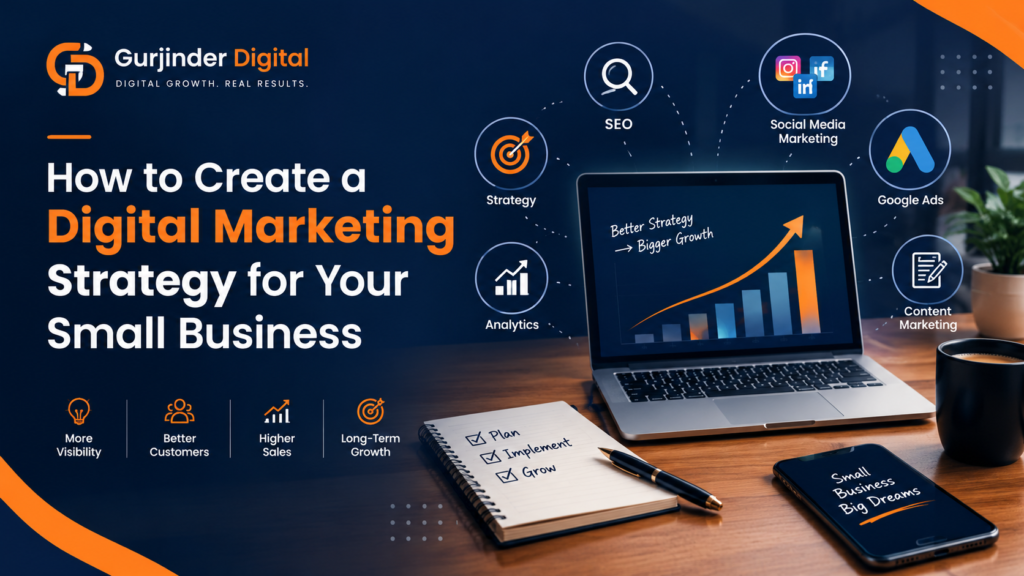
Let’s be honest—running a business is not easy. You have to look after customers, manage your team, handle finances, improve your products or services, and somehow find time to market your business too. Nowadays, marketing your business online has become almost impossible to ignore.
What does that mean?
Think about your behavior. When you need a product or service, what do you usually do? You probably search Google, check Instagram, look at reviews, or visit a website before deciding.
Your customers are doing the thing.
That’s why a marketing strategy can make a difference for your business. No, you don’t need a marketing budget or a large team to get started. You just need a plan.
So let’s break it down into steps.
Start With a Clear Goal**
Before you start posting on Instagram, writing blogs, or running Google Ads, ask yourself one question:
“What do I actually want from marketing?”
Maybe you want more people to visit your website. You can use phone calls or WhatsApp for enquiries. Perhaps you simply want more people to know about your brand.
Your goal could be getting leads, increasing sales, or building awareness.
You don’t have to focus on everything at once
For example, if you own a salon, your main goal might be getting appointment bookings. If you run a clothing store, your focus might be increasing sales.
Once you know what you want, choosing the marketing channels becomes much easier.
This small step can make many of your marketing decisions much simpler.
**Know Who You’re Trying to Reach**
Here’s a common mistake many small businesses make: trying to sell to everyone.
The next step is setting a goal.
It sounds like an idea, but it usually makes marketing harder.
Instead, think about your customer. For example:
Who are they?
What do they need?
What problems are they facing?
What kind of content do they like?
Where do they spend their time online?
For example, suppose you run a fitness centre. Your ideal customers might be college students, young professionals, or people who want to lose weight and become healthier.
Your content and advertising should speak directly to those people.
The better you understand your audience, the easier it becomes to create marketing that feels relevant and not random.
**Make Sure Your Business Looks Professional Online**
Now imagine someone hears about your business and searches for you.
What do they find?
If your website is outdated, your social media hasn’t been updated in months, or your business information is hard to find, that customer might just move on.
Your online presence doesn’t need to be fancy. It just needs to look professional and make things easy for your customers.
Depending on your business, you should have:
– A professional website
– Easy to call
– Up-to-date business information
Put yourself in the customer’s shoes. If you can quickly understand what you offer, where you are, how much it costs, and how to contact you, you’re already making their decision easier.
**Use SEO to Get Found on Google**
Now let’s talk about SEO.
SEO stands for Search Engine Optimization. In terms of SEO helps your website appear when people search for something related to your business.
For example, imagine you own a marketing agency in Kurukshetra.
Someone might search for: “Digital marketing agency in Kurukshetra.”
If your website is properly optimized, you have a chance of showing up in those search results. For a business, SEO can be especially useful. You can start with these steps:
– Use relevant keywords
– Write clear titles
– Keep your content fresh
One thing to remember: SEO is not a game.
You might not see results in a day. If you keep working on it, SEO can become a source of long-term traffic and leads.
**Don’t Try to Be on Every Social Media Platform**
You don’t need to create an account on every media platform. Instead, find out where your customers actually spend their time.
If you’re targeting audiences and your business is visual, Instagram or YouTube might make sense. If you’re targeting professionals or other businesses, LinkedIn could be more useful.
Remember, social media isn’t about posting content.
Nobody wants to see “Buy” in every post. Instead, try sharing things people actually find useful:
– Tips
– Offers
– Updates
Sound like a person.
People don’t connect with businesses that feel like robots. They connect with stories, experiences, useful information, and people they can trust.
**Use Paid Advertising**
Sometimes organic marketing isn’t enough, especially when you’re trying to get results.
That’s where paid advertising can help.
For example, Google Ads can put your business in front of people who are already searching for what you offer. Imagine someone searches for “AC repair near me.”
An AC repair company can use Google Ads to appear in front of that person at the moment they need the service.
You can also use platforms like Instagram and Facebook to reach your audience.
Here’s my advice: don’t spend a lot of money from day one.
Start with a budget. Test ads. See which audience responds best. Then improve your campaigns based on the results.
The goal isn’t to spend more.
The goal is to get results from the money you’re already spending.
**Create Content That Actually Helps People**
Here’s another way to think about content marketing:
Don’t always ask, “What can I sell?” Ask, “What can I help people with?”
Let’s say you run a marketing agency. Instead of saying, “We provide SEO services,” you could create content like: “How does SEO help a business?”
This type of content can attract people who’re already interested in your industry. When you consistently help people you slowly build trust. When they eventually need your service, your business may be one of the names they remember.
**Don’t Underestimate Reviews**
Before buying from a business, what do many people check? Reviews.
A customer might look at reviews before deciding. That’s why genuine customer feedback can be extremely valuable.
If someone is happy with your product or service, politely ask them to leave a review.
You can also display testimonials on your website.
Don’t buy reviews.
A few honest customer reviews are far better for your reputation than dozens of them.
**Keep an Eye on Your Results**
One of the things about marketing is that you can actually measure what’s happening.
You can look at things like:
– Website visitors
– Social media engagement
– Conversions
You don’t need to become a data expert.
Just ask yourself a question every month:
“What worked?”
For example, maybe your Instagram posts get lots of likes but not enquiries.
At the same time, your Google Ads campaign might be generating customers.
That tells you something.
Use your results to decide where you should spend time and money.
Keep testing and improving.
Finally, remember that digital marketing is not a “set it and forget it” thing. Your customers change. Trends change. Platforms change. Competitors change.
So your strategy should change too. Maybe SEO is bringing you traffic. Maybe Instagram is generating enquiries. Maybe Google Ads works well for one service but not another.
Pay attention to these things.
You don’t have to change your strategy every week. Just keep testing and improving what already works.
Don’t feel like you need to do everything at
Start with one or two channels that make sense for your business. Get comfortable with them.
Measure the results.
Then expand.
**Final Thoughts**
Creating a marketing strategy for your business doesn’t have to be complicated.
You don’t need a budget.
You don’t need to be active on every platform.
You don’t need to copy what every other business is doing.
Start with the basics:
– Know your goal
– Know your audience
– Build a presence
– Work on SEO
– Create content
– Use media wisely
– Try paid advertising when it makes sense
– Keep track of your results
Importantly, give it time.
Importantly, give it time.