Digital Marketing: The Complete Guide to Growing Your Business Online
Traditional marketing alone can no longer carry a business forward. Customers now research products, compare providers, and make purchasing decisions almost entirely online — which means a company’s digital presence has become as important as its product itself. Digital marketing gives businesses of every size, from local shops to global enterprises, a direct, measurable, and scalable way to reach the right audience and convert attention into revenue.
What Digital Marketing Actually Delivers
Digital marketing is the use of internet-based channels and technologies to promote products and services. What separates it from traditional advertising is precision: campaigns can be targeted by demographics, interests, location, and real-time online behavior. That precision means marketing spend goes toward people who are actually likely to buy — not a broad, undifferentiated audience. The result is advertising that feels less like a broadcast and more like a conversation with the right person at the right time.
The other defining advantage is measurability. Every click, impression, and conversion can be tracked. Analytics platforms reveal exactly which channels drive traffic, which campaigns generate revenue, and where budget is being wasted. This turns marketing from a guessing game into a discipline of continuous, data-backed improvement.
Search Engine Optimization: The Foundation of Organic Growth
Search Engine Optimization (SEO) determines whether a business is visible at the exact moment someone is searching for what it offers. Since most buying journeys start with a search engine, ranking well on Google is not optional — it’s foundational. Strong SEO combines well-structured content, fast page performance, authoritative backlinks, and a frictionless user experience. Done correctly, it builds a compounding source of traffic that doesn’t disappear the moment ad spend stops.
Content Marketing: Earning Trust Before Earning a Sale
Content marketing — blogs, guides, videos, and infographics — works by solving problems before asking for a sale. Instead of pushing a product, it demonstrates expertise and answers the questions a potential customer already has. Businesses that publish consistently useful content build authority in their space, and that authority does double duty: it earns customer trust and it reinforces SEO by strengthening keyword relevance and topical depth.
Social Media Marketing: Where Brands Build Relationships
Platforms like Instagram, LinkedIn, Facebook, X, and YouTube let businesses do more than broadcast — they let brands respond, engage, and build community in real time. Social channels are where audiences form first impressions, evaluate credibility, and decide whether a brand is worth following. Sustained engagement here doesn’t just build loyalty; it consistently feeds traffic back to the website.
Pay-Per-Click Advertising: Immediate, Intent-Driven Visibility
Pay-Per-Click (PPC) advertising is the fastest route to visibility. Platforms such as Google Ads put a business in front of people who are actively searching for a specific product or service — and because advertisers only pay for actual clicks, well-run campaigns can be remarkably cost-efficient. The formula is straightforward but requires discipline: precise keyword targeting, compelling ad copy, and landing pages built to convert.
Email Marketing: The Highest-ROI Direct Channel
Email remains one of the most effective digital marketing channels because it’s a direct, owned line of communication — no algorithm stands between the business and the customer. Personalized campaigns nurture leads, promote new products, and re-engage past customers, while modern automation triggers the right message at the right stage of the buyer’s journey, without manual effort.
Local SEO: Winning the “Near Me” Search
For businesses that serve a specific geographic area, local SEO is decisive. An optimized Google Business Profile, strong customer reviews, and consistent business information across directories determine whether a company shows up when someone searches “near me.” Businesses that get this right capture high-intent local traffic that competitors miss entirely.
AI and the New Era of Marketing Efficiency
Artificial intelligence has changed what’s possible in digital marketing — from content generation and customer support to predictive analytics and audience segmentation. AI tools let businesses process large volumes of data quickly, spot patterns human teams would miss, and deliver personalization at a scale that was previously unreachable. As the technology matures, it’s becoming less of an advantage and more of a baseline expectation.
Mobile Optimization: A Non-Negotiable Standard
With the majority of internet traffic now coming from smartphones, a mobile-friendly, fast-loading website is not a nice-to-have — it’s a requirement. Mobile experience directly affects both user satisfaction and search rankings, making it one of the simplest, highest-impact areas for a business to get right.
Why Trust Is the Real Currency
Every channel above serves one underlying goal: trust. Consistent branding, honest communication, real testimonials, and genuinely useful content are what turn a first-time visitor into a repeat customer — and a repeat customer into a referral source. Businesses that prioritize trust outperform competitors who prioritize short-term conversion tactics alone.
The Bottom Line
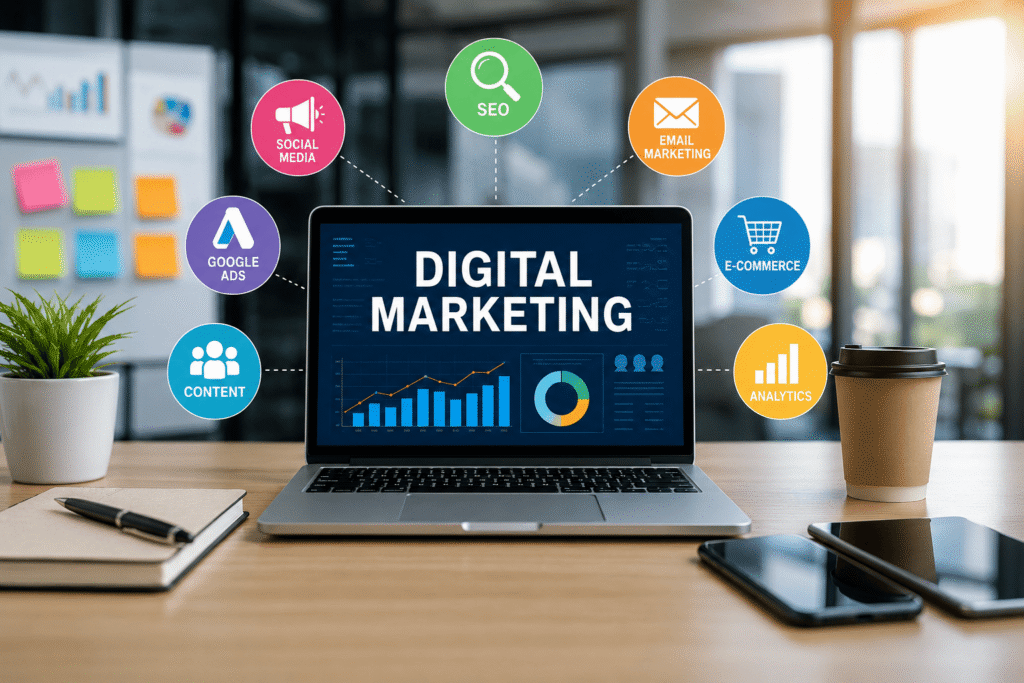
Digital marketing isn’t a single tactic — it’s a system. SEO earns visibility, content and social media build trust, PPC and email drive conversion, and AI and mobile optimization make the entire system faster and more precise. Businesses that integrate these channels into one coherent strategy — rather than treating them as separate checkboxes — are the ones positioned to grow sustainably in an increasingly digital marketplace.