Google Ads
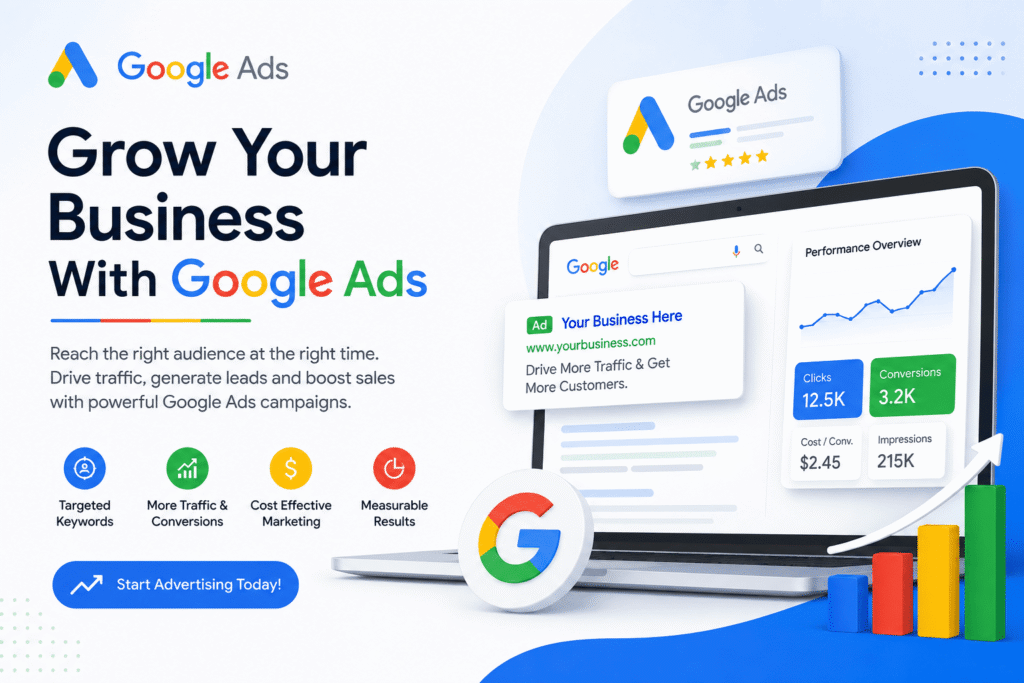
Introduction Begin the article by introducing Google Ads as one of the most effective online advertising platforms for businesses of all sizes. Explain that in today’s competitive digital world, simply having a website is not enough. Businesses need targeted advertising to reach potential customers who are actively searching for their products or services. Mention that Google Ads allows advertisers to display ads across Google Search, YouTube, Google Maps, Gmail, the Google Display Network, and millions of partner websites. Explain that Google Ads follows a Pay-Per-Click (PPC) model, meaning advertisers generally pay only when someone clicks on their ad. Highlight how businesses can set their own budgets, choose their target audience, monitor campaign performance in real time, and optimize ads for better results. Conclude the introduction by telling readers that this guide will cover what Google Ads is, why it matters, campaign types, ranking factors, best practices, common mistakes, useful tools, and tips for creating successful advertising campaigns. What is Google Ads? Define Google Ads as Google’s online advertising platform that enables businesses to promote products and services through paid advertisements. Explain that advertisers bid on relevant keywords so their ads can appear when users search for related information on Google. Describe how Google uses an auction system that considers both the advertiser’s bid and the Quality Score to determine which ads appear and in what order. Explain that Google Ads supports multiple advertising formats, including text ads, image ads, video ads, shopping ads, and app promotion ads. Mention that businesses can target users based on keywords, location, language, device, interests, demographics, and online behavior. Also explain the difference between organic search results, which are earned through SEO, and paid ads, which appear because advertisers invest in Google Ads. Emphasize that Google Ads delivers fast visibility while allowing businesses to measure clicks, impressions, conversions, and return on investment (ROI). Why Google Ads is Important Explain why Google Ads has become an essential part of digital marketing. Discuss how it helps businesses reach customers exactly when they are searching for products or services, making it one of the most effective forms of intent-based marketing. Mention that businesses can increase brand awareness, generate qualified leads, boost website traffic, and drive online or offline sales through targeted advertising. Highlight the flexibility of Google Ads, allowing advertisers to choose daily budgets, bidding strategies, geographic targeting, and audience segmentation according to business goals. Explain that detailed reporting and conversion tracking help businesses measure campaign performance and make data-driven decisions. Also discuss how Google Ads benefits local businesses, e-commerce stores, startups, service providers, and large enterprises by delivering scalable advertising solutions that can grow with the business. Types of Google Ads Campaigns Introduce the various campaign types available in Google Ads and explain how each serves different marketing objectives. Search Campaigns Explain that Search Campaigns display text advertisements on Google’s search results when users search for relevant keywords. These campaigns are ideal for generating leads, inquiries, phone calls, and website traffic from users with high purchase intent. Display Campaigns Describe Display Campaigns as visually engaging banner advertisements shown across millions of websites, mobile apps, and Google-owned platforms. Explain how these campaigns help build brand awareness, retarget previous visitors, and reach new audiences. Shopping Campaigns Explain that Shopping Campaigns are designed for e-commerce businesses. They display product images, prices, reviews, and store information directly in Google Search, making it easier for customers to compare products before purchasing. Video Campaigns Discuss Video Campaigns on YouTube and partner websites. Explain how businesses use video advertising to increase brand awareness, product demonstrations, customer engagement, and conversions through engaging visual content. Performance Max Campaigns Explain that Performance Max uses Google’s artificial intelligence to automatically optimize campaigns across Search, Display, YouTube, Gmail, Discover, and Maps. Highlight its ability to maximize conversions by finding the best audience and placements. App Campaigns Describe App Campaigns, which help businesses promote mobile applications by increasing app downloads, user engagement, and in-app conversions across Google platforms. Demand Gen Campaigns Briefly explain Demand Gen campaigns, which use visually rich creatives to reach users across YouTube, Discover, and Gmail. These campaigns are particularly effective for generating awareness and demand before customers actively begin searching. Key Google Ads Ranking Factors Explain that Google determines ad placement using several important ranking factors rather than considering only the highest bid. Discuss Quality Score, which measures ad relevance, expected click-through rate (CTR), and landing page experience. Explain that advertisers with highly relevant ads often achieve better positions while paying lower costs. Describe the importance of keyword selection, bidding strategy, ad copy quality, landing page speed, mobile responsiveness, ad assets (extensions), user location, device type, and audience targeting. Mention that Google also considers the competitiveness of the auction and the overall user experience when calculating Ad Rank. Emphasize that improving these factors can increase visibility while reducing advertising costs. Best Google Ads Strategies Provide practical strategies for running successful Google Ads campaigns. Explain the importance of conducting detailed keyword research to identify high-intent search terms. Recommend writing compelling headlines and persuasive descriptions with clear calls to action that encourage users to click. Discuss optimizing landing pages to match ad messaging and provide a smooth user experience. Explain the value of using ad assets such as sitelinks, call extensions, location extensions, and structured snippets to improve ad visibility. Encourage businesses to monitor conversions, perform A/B testing, adjust bidding strategies, add negative keywords, remarket to previous website visitors, and continuously optimize campaigns based on performance data. Reinforce that consistent monitoring and improvement are essential for long-term advertising success. Common Google Ads Mistakes Discuss common mistakes that reduce campaign performance and increase advertising costs. Explain why targeting overly broad keywords, ignoring negative keywords, creating weak ad copy, or sending users to irrelevant landing pages often leads to poor results. Mention technical issues such as slow-loading pages, lack of mobile optimization, and failing to track conversions. Also explain the risks of choosing the wrong bidding strategy, ignoring audience segmentation, failing to test different ad variations, and neglecting campaign